
As parents in the digital age, we do everything we can to keep our kids safe. We set up network controls (perhaps even one of our own All Families Secure networks), we enable 'SafeSearch' on Google, and we have "the talk" about online strangers and digital footprints. We’ve built a strong digital fence.
But what happens when the kids are inside that fence?
Many of us have felt that nagging worry. The house is quiet—too quiet. We check on our child, and sure enough, they’re staring intently at their tablet or phone. They might be watching "safe" videos or playing an approved game, but they’ve been at it for hours. The digital filter is working, but it hasn’t solved the whole problem.

At All Families Secure, we believe in a holistic approach to family safety. Our Child Safe Networks are the foundation for a secure online world, but they are one essential layer. The other, equally crucial layer, is managing physical access to devices. Here’s why creating real-world boundaries is just as important as creating digital ones.
It’s Not Just What They See, It’s How Long They See It
This is the heart of the "screen time" debate. A network filter is brilliant at blocking harmful content, but it doesn't automatically teach moderation. Even an endless stream of "good" content—educational apps, creative games, or family-friendly videos—can have negative impacts when consumed without limits.
We know this instinctively. We wouldn’t let our kids eat nothing but healthy broccoli for three hours straight, either. Variety is key.

Unmoderated screen time can affect:
- Sleep: The blue light from screens is notorious for disrupting melatonin production, making it harder for kids (and adults!) to fall asleep and get the deep, restorative rest they need.
- Focus: Constant digital stimulation can shorten attention spans, making "boring" but essential tasks like homework or reading a book feel much more difficult.
- Family Connection: When a device is always available, it can become a default setting. It fills the "in-between" moments at the dinner table, in the car, or during family movie night, replacing opportunities for conversation and connection.
A physical boundary—like putting the device in a box or a different room—is the clearest "off" switch there is. It's not a punishment; it's a non-negotiable signal that it's time for the brain and the body to do something else.
Creating Space for 'Green Time', Not Just Screen Time
Have you ever heard the expression "touch grass"? It's a popular online term for logging off and reconnecting with the physical world. As Aussie families, we are blessed with a lifestyle that celebrates the outdoors, but we're fighting an uphill battle against the magnetic pull of the digital world.
If a child has the choice between the easy, predictable dopamine hit of a video game and the "effort" of finding something to do outside, the screen often wins. It's the path of least resistance.
Physically removing the device changes the equation. It re-opens the door to:
- Boredom: This is not a bad word! Boredom is the engine of creativity. It’s in those quiet, "boring" moments that a child picks up a pencil and draws, builds a complex Lego world, or starts a new project.
- Physical Play: Kicking a footy in the backyard, riding a bike around the neighbourhood, or even just helping in the garden. This is vital for physical health, coordination, and burning off the energy kids need to expend.
- Social Skills: Real-world interaction is messy, unscripted, and essential. It's how kids learn to read facial expressions, navigate disagreements, and build lasting friendships—skills that are much harder to develop through a screen.
By creating device-free times, we aren't just taking something away; we are giving our kids the opportunity to rediscover the joy of the analogue world.

Staying Ahead of Trouble You Can’t Anticipate
Even the best network security controls have one limitation: they can only protect against known threats or categories. Our systems at All Families Secure are updated constantly, but the internet moves at lightning speed. New apps, new slang, and new social trends appear overnight.
The "unanticipated" trouble is what keeps many parents up at night. This isn't just about accessing a "bad" website. It could be:
- Cyberbullying: This can happen in "safe" spaces, like the team chat of an approved online game or a private message on a kids' social platform.
- In-Game Purchases: A "safe" game can quickly become a source of conflict when children make unauthorised purchases.
- Obsessive Behaviour: A child might spend hours watching seemingly innocent Minecraft tutorials, but this can still develop into an unhealthy, obsessive habit that crowds out other interests.
- Clever Workarounds: Kids are incredibly smart. They will often spend hours trying to find a loophole in the rules or a workaround for a filter, simply for the challenge.
No filter can block everything. The only 100% effective tool against unanticipated online risks is for the device to be switched off and put away. Time away from the screen is guaranteed time safe from these evolving dangers. It gives you, the parent, a chance to catch your breath and catch up, without worrying about what new trend has just emerged.
Our Family’s Solution: The 'Out of Sight, Out of Mind' Box
As a parent myself, I've tried all the strategies. We’ve had the "devices on the bench at dinner" rule. We've tried the "no devices in bedrooms" rule for bedtime. The problem was that the devices were still visible. They were still a temptation, and the rules were a constant source of negotiation and friction. I personally broke the "devices on the bench at dinner" rule a few times - something my kids were only too eager to point out.
My family has finally found a solution that works for us, and it’s beautifully simple. We use a Lockabox.
It's essentially a, combination-lock box. It's not a high-tech steel safe; it's a powerful visual boundary. When it's "device-free time", the phones and tablets go in the box, and the code is set. The negotiations just… stopped. It's a clear, non-emotional rule.
What makes this particular solution so effective for a modern family are two key features.
- It has cable pass-throughs. This is the genius part. We can run charging cables into the locked box. The devices aren't just being locked away in a "naughty box"; they're in their "charging and resting station," powering up safely for the next day.
- It’s made of plastic, not metal. This was an unexpected bonus. Because it’s not a metal safe (which would block signals), our Wi-Fi still gets through. This is perfect, as it means the devices can still connect to our All Families Secure network to receive critical security patches and software updates while they are safely locked away.
It's the perfect "out of sight, out of mind" solution that also ensures the tech is charged, updated, and secure.
Your Family’s Safety Team
A secure network filter is your digital seatbelt—it's an essential, non-negotiable layer of protection. But it works best as part of a complete safety plan.
Think of your network security and your physical boundaries as a team. Your network (like our Child Safe Network) manages the content and protects against threats. Your physical solution (like a simple lockbox) manages access and teaches balance.
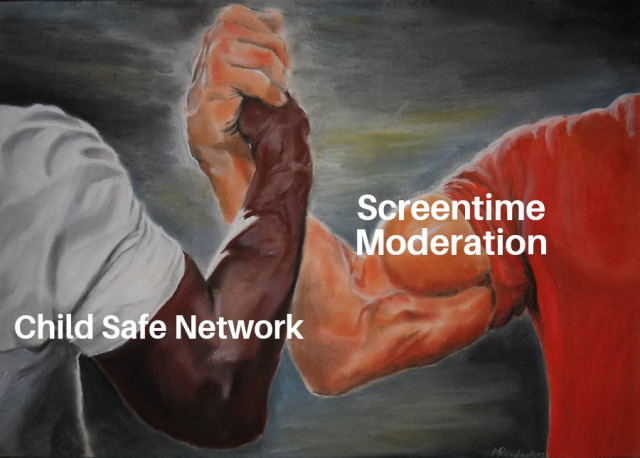
Together, they provide the comprehensive peace of mind that all families deserve. You get to relax, knowing the digital world is filtered, and the real world is being enjoyed.
At All Families Secure, we believe in empowering you with the right tools for the whole job. If you’d like to learn more about building the foundational layer of your family's digital safety, we invite you to book a free, zero-obligation consultation with our Melbourne-based team today. Let's create a secure environment, together.